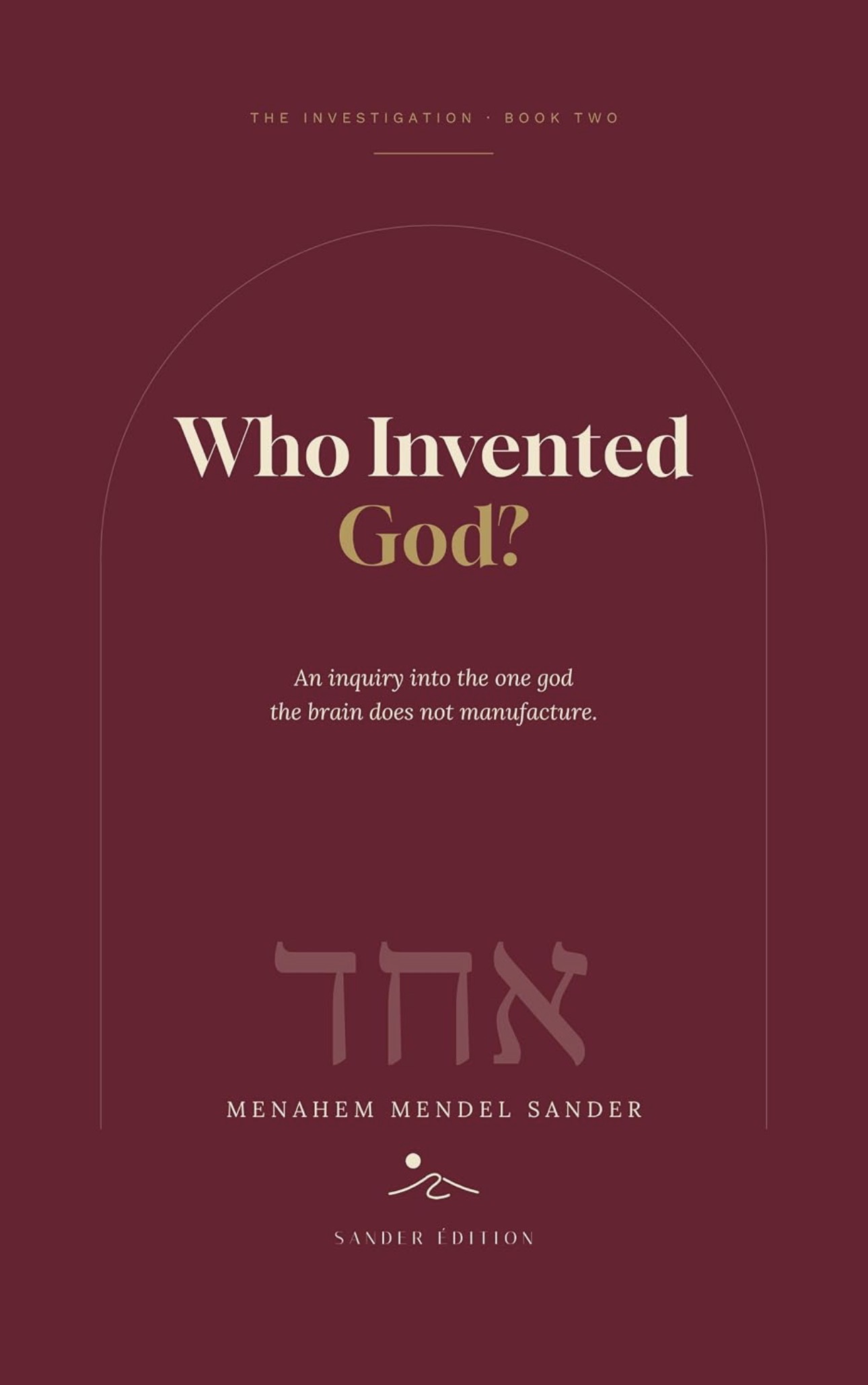
Who Invented God? — An Inquiry into the One God the Brain Does Not Manufacture
Book Two of The Investigation. Why can the cognitive sciences readily explain Zeus, spirits, and ghosts—but not the one bodiless, image-less God of the Torah? A critical inquiry into the naturalistic account of God’s invention.
Modern science believes it has answered the question in the title.
For thirty years, the cognitive sciences have been describing a god-making machine: a brain that sees intentions everywhere, a memory that keeps almost-human stories, a mind that lends a purpose to everything. Multiply by the centuries and you get what humanity has in fact produced—spirits, ancestors, pantheons. The case looks closed.
This book exists because one detail does not fit, and it is enormous. Look at what the machine manufactures: gods with bodies, faces, and territories, gods that can be carved, fed, and swayed. Zeus is natural. Ghosts are natural. Yet one concept violates every one of those rules: one God, without body, of whom no image is possible, whom no rite manipulates. Cognitively, it is the worst product in the catalog—the one the machine does not make. It is exactly the God of the Torah.
Out of that anomaly, an inquiry
Book Two of The Investigation, after Who Wrote the Torah?, this volume takes the best of the opposing science seriously—and does not hide its weaknesses, including where they serve its own case.
- The machine, described at full strength. Hyperactive agency detection, minimally counter-intuitive concepts, theological correctness, promiscuous teleology—the standard model of the field, with the laboratory results that support it and the replications that failed.
- The anomaly. The prohibition of images and the reason the text itself gives; the God who cannot be thought; the war on divinatory technique; the Rambam as the first cognitivist; and what the Golden Calf proves in spite of itself.
- The comparative test. Every alleged precedent put through the sieve: Akhenaten, Zarathustra, the Greek philosophers, and the Near Eastern parallels—four criteria, declared in advance.
- Two centuries of suspicion, arraigned one by one. Projection, consolation, the opium of the people, the social totem, the god of the gaps, faith against reason, Euthyphro, and “it is all a late myth”—each stated at its strongest before it is answered.
- The fair trial. The book then argues against itself, giving the best naturalistic explanations—Römer’s slow purification, the big-gods hypothesis, the learned counter-intuitive—their full weight.
The verdict is not a proof, and the author says so in as many words. It is a shift. The skeptic can no longer say: “one invention among others.” He has to say: “the most improbable invention in the history of ideas”—and that position has a price.
Every argument is carried by an exhibit quoted word for word, with its full reference and permanent digital identifier. Every chapter closes by stating what it does not prove, before an opponent has to point it out.
Four appendices
- A chronology of the suspicion and its testing
- A who’s who
- A glossary
- A full bibliography
Also by the author: Who Wrote the Torah? · Shmirat HaGuf · Shmirat HaNefesh · Shmirat HaDerech