
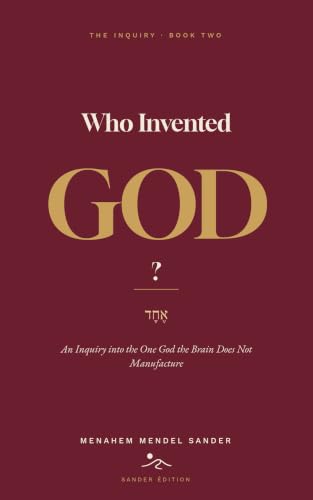
Modern science believes it has answered the question in the title. For thirty years, cognitive science has described a god-making machine: a brain that sees intentions everywhere, remembers almost-human stories, and lends a purpose to everything.
Your turn: If the brain helps produce a belief, does that prove it false? Ten questions to test the inference. Take the 10-question quiz → The explained answer key comes by email; the news list is optional.
That model readily explains spirits, ancestors, pantheons, Zeus, and ghosts. But one enormous detail does not fit: the one bodiless God of the Torah, of whom no image is possible and whom no rite can manipulate. Cognitively, this is the worst product in the catalog—the one the machine does not make.
Out of that anomaly, an inquiry
Who Invented God? is Book Two of The Investigation, after Who Wrote the Torah?. It takes the best of the opposing science seriously and does not hide its weaknesses, including where they serve its own case.
- The machine, described at full strength: agency detection, minimally counter-intuitive concepts, theological correctness, and promiscuous teleology.
- The anomaly: the prohibition of images, the God who cannot be thought, the war on divinatory technique, the Rambam, and the Golden Calf.
- The comparative test: Akhenaten, Zarathustra, the Greek philosophers, and the Near Eastern parallels.
- The fair trial: the book argues against itself and gives the strongest naturalistic explanations their full weight.
The verdict is not a proof. It is a shift: the skeptic can no longer say “one invention among others,” but must account for the most improbable invention in the history of ideas.
Every argument is carried by an exhibit quoted word for word, with its full reference and permanent digital identifier. Every chapter closes by stating what it does not prove. Four appendices complete the inquiry: chronology, who’s who, glossary, and full bibliography.